The Tower Of London has marked the 100th anniversary of the outbreak of the First World War with a striking art installation.
Blood Swept Lands and Seas of Red by Paul Cummins features thousands of ceramic poppies pouring out of the tower flowing into the moat and will officially be unveiled on August 5.
The final poppy will be planted on November 11.
There will be a total of 888,246 poppies planted, with each flower representing a British military fatality from WW1
Cash can no longer be used on any of London's buses in a move that Transport for London (TfL) says will save £24m a year.
Passengers will need a prepaid or concessionary ticket, Oyster card or a contactless payment card to travel.
TfL said only 0.7% of all bus journeys were paid for with cash and that tourists were unlikely to be affected. But the Green Party said more ticket outlets were needed and questioned how vulnerable passengers would cope.
TfL said its research showed the move, which came into force at 04:30 BST, was unlikely to affect tourists "as the vast majority use a prepaid ticket, such as a Visitor Oyster, to get around the capital".
'Highly inadequate'
Its drivers have been asked to guide vulnerable people.
Last month TfL introduced the "one more journey" feature for Oyster users, allowing passengers to make one further trip if they have insufficient credit on their card, which TfL said had benefitted around 44,000 customers a day.
Mike Weston, TfL's director of buses, said: "Removing cash from our bus network not only offers customers a quicker and more efficient bus service but it enables us to make savings of £24m a year which will be re-invested to further improve London's transport network."
But Green Party London Assembly member Darren Johnson said questions remained over whether passengers who lost or damaged their Oyster cards would be allowed to travel at all, saying that more than 2,100 Oyster cards were lost, stolen or stopped working on the average day last year.
Mr Johnson said: "I am very concerned that TfL are only planning 19 new Oyster ticket stops in preparation for the cashless switchover.
This seems highly inadequate, especially when every ticket office across the tube network is going to be closed. "I also have serious concerns about the impact which this sweeping change could have on vulnerable passengers."
What is the history of the three lions on the English football shirt?
The lions have a history going back to the 12th century, when a standard with three gold lions on a red field was carried into battle to inspire the troops. The first one came from Henry I - known as the lion of England - who had a lion on his standard on taking power in 1100. Shortly afterwards he married Adeliza, whose father also had a lion on his shield, and to commemorate the event he added a second lion to his standard. In 1154, two lions became three when Henry II married Eleanor of Aquitaine, who - yes, you've guessed it - also had a lion her family crest. Later that century, Richard the Lionheart (1189-1199) used the three golden lions on a scarlet background as a symbol of the English throne and, after that, it appeared on the Royal Arms of every succeeding monarch. So when the FA was formed in 1863, it seemed natural enough to base their logo on this stirring royal shield. Since then, the design has only been changed once, in 1949 - when the crown that was on top of the lions was removed to differentiate the badge from that of the English cricket team.
You use words like “whilst”, “shall”, “peckish” and “knackered” and don’t drop the u’s when spelling words like colour, favourite and humour.
You have no trouble understanding the dialect in British movies such as Billy Elliott, The Full Monty and Trainspotting.
You subscribe to more British magazines than you do American ones.
You know how to make a proper cup of tea and enjoy a nice biscuit.
You can explain to people why the British drive on the “other” side of the road.
You know how to display the Union Flag right side up.
You watch so much British telly that on most days the only non-British accents you hear belong to your family members.
You know the UK Top 10 charts by heart, but have no clue what’s playing on local radio.
You have a closet full of Union flag clothing but struggle to find anything patriotic to wear on the 4th of July.
You follow the weather in the UK and can convert Celsius to Fahrenheit in your head.
You can’t remember the American words for courgette, aubergine or rocket.
You know when it’s St. George’s Day, St. Andrew’s Day and St. David’s Day.
You know more about what’s going on in the U.K. than you do your own country.
Your Facebook page is set on British English instead of American English.
Your computer clock is set to UK time and you celebrate the New Year at midnight, GMT.
Your Facebook and Twitter feeds are full of posts by sites like Smitten by Britain!
You have Siri or your GPS set to a voice with a British accent.
You spend your free time writing a blog about Great Britain!
Timeline
It’s hard to believe, but when The EDF Energy London Eye was launched as The Millennium Wheel, it was only going to be standing for a few years. But today, the London Eye has become a symbol of modern Britain; it is the UK’s number one paid-for visitor attraction and film set for TV shows and movies.
Along the way, there have been plenty of milestone moments, have a look on our timeline below.
January 2011
The London Eye enters a new partnership with EDF Energy and becomes the EDF Energy London Eye.
November 2010
The London Eye lauches the first ever open air ice rink on the south bank, in the shadow of the London Eye.
December 2009
We continue to make history with the 36 million flights on the London Eye..
August 2009
The London Eye launches a spectacular new 4D Experience.
The London Eye goes through a re-branding.
May 2009
the London Eye launches its capsule upgrade programme with removal of the first capsule
London.
June 2008
We made history with the 30 million flights on the London Eye..
May 2008
The London Eye River cruise celebrated its millionth guest.
March 2007
The 25 millionth visitor was welcomed to the London Eye
March 2007
The London Eye became part of the Merlin Entertainment’s Group, the world’s number two visitor attraction operator.
February 2006
The London Eye was finally granted a 25 year lease agreement.
December 2005
The first civil partnership was performed on the London Eye. To mark the occasion, the London Eye was turned pink.
March 2005
The London Eye had its fifth birthday - 7,000 quarter bottles of Laurent-Perrier Champagne and 3,000 bottles of orange juice were given away so customers could join in the party .
February 2004
The London Eye kept turning until midnight for the first time to give lovers a romantic moment on St. Valentine’s Day.
September 2002
Our 10 millionth flight took place.
August 2002
The London Eye River Cruise was launched, quickly becoming a favourite way to see London from the River Thames.
February 2002
A new idea for Valentines Day and lovers - wedding packages allowing people to get married on the London Eye were introduced .
January 2002
The Euro was accepted at the London Eye
March 2001
The London Eye celebrated its first official birthday. During the first year alone, more than 3.5 million people came on board to fly above London.
March 2000
The London Eye officially opened to the public
October 1999
The London Eye was raised over the River Thames
Late 1998
Construction started on The London Eye, a huge international effort involving hundreds of people.
There are many parks and open spaces in London, England. Green space in central London consists of five Royal Parks, supplemented by a number of small garden squares scattered throughout the city centre. Open space in the rest of the city is dominated by the remaining three Royal Parks and many other parks and open spaces of a range of sizes, run mainly by the local London boroughs, although other owners include the National Trust and the City of London Corporation.
Royal parks
The centrepieces of London's park system are the eight Royal Parks of London. Covering 1976 hectares, they are former royal hunting grounds which are now open to the public. Four of these — Green Park (16 ha), St. James's Park (34 ha), Hyde Park (140 ha), and Kensington Gardens (111 ha) — form a green strand through the western side of the city centre, whilst a fifth, Regent's Park (197 ha) is just to the north. The remaining three Royal Parks are in the suburbs — Greenwich Park (73 ha) to the south east, and Bushy Park (450 ha) and Richmond Park (955 ha) to the south west.
Garden squares
Many of the smaller green spaces in central London are garden squares, which were built for the private use of the residents of the fashionable districts, but in some cases are now open to the public. Notable examples open to the public are Russell Square in Bloomsbury, Lincoln's Inn Fields in Holborn and Soho Square in Soho.
The Royal Borough of Kensington and Chelsea contains over a hundred garden squares whose use is restricted to residents. The upkeep of these squares is paid for through a levy on top of residents' council tax.
Council parks
The bathing pond at Victoria Park. Unused for bathing since the 1930s.
In addition to these spaces, a large number of council-owned parks were developed between the mid 19th century and the Second World War, including Victoria Park (86.18 ha), Alexandra Park (80 ha) and Battersea Park (83 ha).
Why are the buses red?
Before 1907, buses were painted in different colours to signify their route. Due to fierce competition between bus companies, London General Omnibus Company (LGOC) – which became the biggest bus operator in the capital – painted their fleet of buses red in order to stand out from the competition. After encouragement from the Metropolitan Police they also introduced numbers on the buses to signify different routes.
Two iconic Routemasters are still in use
The Routemaster bus is symbolic of London but this couldn’t save them from being withdrawn from service on 9th December 2005. They were replaced with easy access low-floor buses. However two Routemasters are still in use today on heritage routes. These are Route 9 from Kensington High Street to Aldwych and Route 15 from Trafalgar Square to Tower Hill.
A competition found the new London bus design
In his 2008 election campaign, Boris Johnson vowed to bring the Routemaster back to London. The design of the bus was subject to a competition, with international design companies submitting entries. The winning designs were chosen, altered slightly, and in 2010 the final design was unveiled.
The Knight Bus was commissioned in 1865
Well, at least that's what J.K. Rowling would have you believe. The bus seen in the film Harry Potter and the Prisoner of Azkaban was constructed using three RT-Class AEC Regent III buses. It is summoned by sticking your wand in the air, as a muggle might hail a taxi. The service is generally used by wizards who are underage or infirm. Hot chocolate is available for the sum of thirteen sickles and there are many beds on which to rest a wizard's head.
The bus in Cars 2 is named Topper Deckington III
The iconic Routemaster bus makes a cameo appearance in the Pixar film Cars 2. Named Topper Deckington III, his route around Killswitch goes via Carford Street, Shiftly Road and Petroldilly Circus. One bus features an advert for ‘Calahan’s Gastropub & Knittery’ which is a reference to the film's lighting director Sharon Calahan.
The London Underground (also known as the Tube) is a public metro system serving a large part of Greater London. The system serves 270 stations and has 402 kilometres of track, 55% of which is above ground.
The system's first tunnels were built just below the surface using the cut and cover method. Later, circular tunnels – which give rise to its nickname the Tube – were dug through the London Clay at a deeper level. The early lines were marketed as the UNDERGROUND in the early 20th century on maps and signs at central London stations.
As of 2012, 91 per cent of operational expenditure is covered by passenger fares. The Travelcard ticket was introduced in 1983 and Oyster, an electronic ticketing system, in 2003.
Today in official publicity and in general, the term 'Tube' embraces the whole Underground system. The schematic Tube map, designed by Harry Beck in 1931, was voted a national design icon in 2006. London Underground celebrated 150 years of operations in 2013, with various events marking the milestone.
A bank holiday is a public holiday in the United Kingdom, Commonwealth countries, other European countries such as Switzerland, and a colloquialism for a public holiday in Ireland.
There is no automatic right to time off on these days, although banks close and the majority of the working population is granted time off work or extra pay for working on these days, depending on their contract.
Prior to 1834, the Bank of England observed about 33 saints' days and religious festivals as holidays, but in 1834 this was reduced to four: 1 May (May Day), 1 November (All Saints Day), Good Friday, and Christmas Day.
In 1871, the first legislation relating to bank holidays was passed when Liberal politician and banker Sir John Lubbock introduced the Bank Holidays Act 1871.
The first official bank holidays were the four days named in the Bank Holidays Act 1871, but today the term is colloquially used for public holidays which are not officially bank holidays, for example Good Friday and Christmas Day.
There is a logic that has evolved since olden days about keeping to the left on the road.
In olden days people wanted to protect themselves using their sword while they were passing each other on the road. To accomplish this they had to be in the best possible position to use their sword in order to protect themselves. Since most people were right handed, they felt it convenient to keep to the left and use the sword in their right hand.
A common question that arises is why people drive on the right in other parts of Europe. It is believed that the reason behind this is Napoleon, who after conquering Europe, fixed the major roads and established traffic on the right side. Some believe that he did so to go against the way British travelled, while others believe that it was easier for him to control the horse with his right hand, and hence he made everybody else travel on the same side as he travelled.
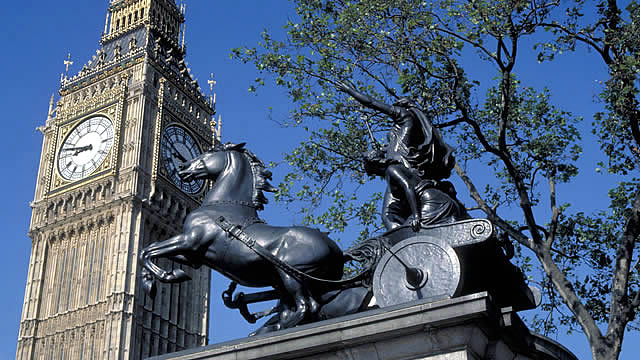
The Houses of Parliament's iconic clock tower is one of London's most famous landmarks.
Big Ben is the nickname of the clock tower at the north end of the Palace of Westminster in London, named after the great bell within the clock.
The tower is officially known as the Elizabeth Tower (prior to being renamed in 2012 it was known as simply "Clock Tower") to celebrate the Diamond Jubilee of Elizabeth II. The tower holds the largest four-faced chiming clock in the world and is the third-tallest free-standing clock tower.
The tower was completed in 1858 and had its 150th anniversary on 31 May 2009, during which celebratory events took place.
The tower has become one of the most prominent symbols of the United Kingdom and is often in the establishing shot of films set in London.
Afternoon Tea is a tea-related ritual, introduced in Britain in the early 1840s. It evolved as a mini meal to stem the hunger and anticipation of an evening meal at 8pm.
Afternoon Tea is a meal composed of sandwiches (usually cut delicately into 'fingers'), scones with clotted cream and jam, sweet pastries and cakes. Interestingly, scones were not a common feature of early Afternoon Tea and were only introduced in the twentieth century.
Afternoon Tea was initially developed as a private social event for ladies who climbed the echelons of society. It was only when Queen Victoria engaged in the Afternoon Tea ritual that it became a formal occasion on a larger scale, known as 'tea receptions'.
These receptions could have as many as two hundred guests with an open 'at home' invitation to visit between 4pm and 7pm, during which they could come and go as they pleased; this was the genesis of the Afternoon Tea as we know it.
In Britain today Afternoon Tea is usually enjoyed as an occasional indulgence or to celebrate a special event such as a birthday, or a pre-wedding or baby shower party with a group of friends.
Deep-fried fish in a crispy batter with fat golden chips is still one of Britain and Ireland's favorite meals. The love for them ranks alongside Roast Beef and Yorkshire Puddings, and the recently nominated Chicken Tikka Masala, as the English National Dish.
History
No one knows precisely where or when fish and chips came together. Chips (pommes frites) had arrived in Britain from France in the eighteenth century. The first mention in 1854 was when a leading chef included ‘thin cut potatoes cooked in oil’ in his recipe book, Shilling Cookery. Around this time fish warehouses sold fried fish and bread, with mention of them in Charles Dickens’ novel Oliver Twist published in 1830.
Which Fish?
The UK’s favorite fish is still Cod and accounts for 61.5% of total consumption. Although the North Sea cod stocks issue is a serious problem, Cod landed in the UK is caught within strict management regimes and quota systems setting safe limits for catches agreed by fishermen, scientists and government. Cod caught within these agreed limits is safe for consumers to eat.
Haddock at 25% is the second favorite and regional variations include whiting in Northern Ireland and some parts of Scotland, skate and huss in the south of England.
To Serve?
Very few Britons have adopted the continental habit of mayonnaise with fish and chips, preferring just salt and vinegar sprinkled on.
On the Side?
Love them or hate them, Mushy Peas are the classic accompaniment. Since the mid-seventies a curry sauce has also gained favor as a side dish. The only other sauces considered suitable are a splash of ketchup or in Scotland, some like brown sauce.
Are they healthy?
Compared to other take-away foods Fish and chips have: 9.42 grams of fat per 100 grams. The average pizza has 11, Big Mac meal with medium fries has 12.1, Whopper meal with medium fries has 14.5, chicken korma 15.5 and doner kebab 16.2.
Fish and chips have 595 calories in the average portion - an average pizza has 871, Big Mac meal with medium fries has 888, Whopper meal with medium fries has 892, chicken korma 910 and doner kebab 924.
The Union Jack is a transnational flag full of historical significance.
It represents the union of different countries and the growth of a family of nations whose influence extends far beyond the British Isles.
This far-reaching influence is still seen today in the incorporation of the Union Jack in other national flags such as that of Australia.
The British flag is called the "Union Jack", an expression that needs to be explained.
The Union Jack is a fine expression of unity as well as diversity. The British flag incorporates the national symbols of three distinct countries, England, Scotland and Northern Ireland. In fact its name "Union Jack" emphasises the very nature of the United Kingdom of Great Britain and Northern Ireland as a union of nations. The flag is also known by another name, this too, emphasising the idea of union: the "Union flag", perhaps a less common term but a little more precise. The countries comprising the British Isles are not inward-looking or isolated states with an insular mentality; together they constitute a powerful union that has spanned centuries. Recent devolution that gave Scotland its own Parliament and Wales its own Assembly has also emphasised the importance of individual national identities within the union without affecting the essential unity of Great Britain. On the contrary, it has strengthened it. Recognition of, and respect for national identities are an essential ingredients for effective union. The Union Jack symbolises all this: respect for individuality within a closely knit community.
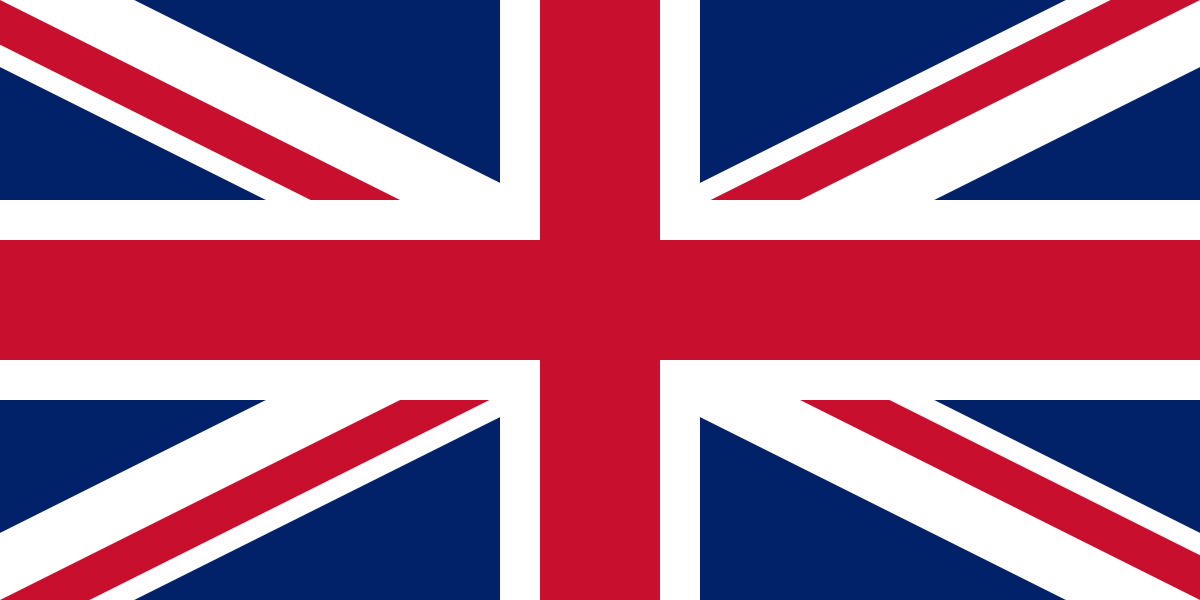
The "Union Jack" or "Union Flag" is a composite design made up of three different national symbols:
The image below renders the idea of the union of the three flags forming one unified, transnational Flag.
The full English breakfast is a centuries old British tradition which dates back to the early 1800's, when the Victorians first perfected the art of eating breakfast and elevated the most important meal of the day into an art form.
When the Victorians combined tradition with the most important meal of the day, they created a national dish, one that is widely loved to this day and regularly enjoyed by millions of English breakfast lovers all over the planet.
The idea of the English breakfast as a unique national dish, stretches back to the thirteenth century and an English institution called the gentry, who could be considered to be the guardians of the traditional English country lifestyle and a group of people who saw themselves as the cultural heirs of the Anglo-Saxons.
The breakfast table was an opportunity to display the wealth of the estate and the quality of the meats, vegetables and ingredients produced on the surrounding land and a chance to show off the skills of the cooks who prepared a vast selection of typical English breakfast dishes every morning, for the residents and guests of the house.
Breakfast served in these country houses was made up of ingredients sourced from farmers based on the estate, the meats were cured and cooked using regional recipes and methods. Their breakfasts were made up of traditional English dishes, cooked in a typical English way and it was here that the idea of the traditional English breakfast began.
Known colloquially as a fry up, the traditional English breakfast is called a full breakfast for good reason, although you do not absolutely have to eat two sausages, three slices of bacon and two fried eggs in order for it to still be traditional.
But whichever way you look at it, the full English breakfast is a substantial meal consisting of back bacon, eggs, British sausage, beans, tomato, mushrooms, black pudding and toast. These ingredients may vary depending on the specific region of the British isles you happen to be in and a subject that is still open to (sometimes quite fierce) debate.